 Stephanie A. Craig
Steph at Big Bend National Park.
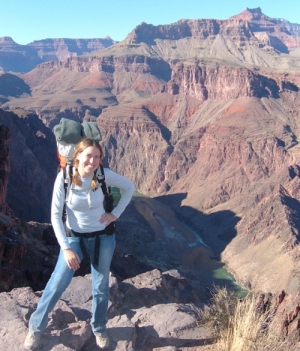
-- backpacking through the Grand Canyon.
EDUCATION:
B.S. (Biology, University Honors Program Graduate) Armstrong Atlantic State University (http://www.armstrong.edu), 2001RESEARCH INTERESTS:
Vibrio cholerae is a formidable human pathogen that has been the cause of extensive epidemics of a severe diarrheal disease and continues to affect many developing countries. Since many strains of V. cholerae, including the pathogenic strains, are natural inhabitants of surface waters and have been isolated from almost every part of the world, it is unlikely that they can be eradicated from the environment. Therefore, an understanding of the ecology of V. cholerae is important to limit the amount of contact humans have with the pathogenic vibrios. V. cholerae has been shown to form robust biofilms, “a community of bacterial cells that is adherent to a surface, interface or each other and encased in a self-produced polymeric matrix” (Stanley), that confer a strong survival advantage to the organism.
Like other microbial pathogens, V. cholerae requires iron for survival and has many distinct iron transport systems to facilitate the uptake and utilization of iron in various forms. V. cholerae can acquire iron through the synthesis, secretion, and subsequent uptake of specific low molecular weight chelators called siderophores through outer membrane receptors. Not only does V. cholerae transport the siderophore vibriobactin, which it synthesizes, but it also has transport systems for exogenous siderophores including enterobactin, ferrichrome, and schizokinen, the siderophore of some cyanobacteria. TonB and its accessory proteins ExbB and ExbD are required for the uptake of iron complexes via ligand-specific high-affinity transport. Another method for iron acquisition is through the action of inner membrane transport systems.
My goal is to determine the roles of various iron transport systems in the environmental survival of Vibrio cholerae, specifically within the context of biofilm formation.
I would like to express my sincerest thanks to Dr. Bob McLean at Texas State University (http://www.bio.txstate.edu/~micro/mclean/mclean.html) and Dr. Marvin Whiteley and his lab at The University of Oklahoma Health Sciences Center (http://w3.ouhsc.edu/mi/whiteley.html) for expert help and advice.
PUBLICATIONS
Mey AR, Craig SA, Payne SM. (2005) Characterization of Vibrio cholerae RyhB: the RyhB regulon and role of ryhB in biofilm formation. Infect. Immun. 73(9): 5706-5719. (Abstract)
ABSTRACTS
S.A.Craig, S.M. Payne. 2006. Iron and Biofilm Formation in Vibrio cholerae. 106th ASM General Meeting.
Mey, A.R., S.A. Craig, S.M. Payne. 2005. Characterization of Vibrio cholerae RyhB: the RyhB regulon and the role of ryhB in biofilm formation. 7th International Symposium on Microbial Iron Transport Storage and Metabolism, Paris, France.
Judy Awong-Taylor, Stephanie A. Craig, Ryan Smith. 2001. Degradation of Chromosomal and Plasmid DNA and the Potential for Transformation of Competent Cells. 101st ASM General Meeting.
Judy Awong-Taylor, Stephanie A. Craig, Ryan Smith. 2000. Chromosomal and Plasmid DNA Degradation and Its Effects on Transformation. 61st Annual Meeting of Southeastern Biologists Conference.